In my eight years as an HR Business Partner at Horizon Inc., I’ve seen my fair share of resignation letters. The polite two-week notices. The “pursuing other opportunities” emails. The occasionally dramatic “I quit!” sticky notes left on monitors. But nothing was as artistic as what landed in my inbox on that Tuesday morning in March.
I was nursing my second coffee of the day when I opened an email from Leo Alvarez, one of our graveyard shift technicians. The subject line read simply: “Notice of Resignation – Visual Format.”
Visual format? I clicked the attachment.
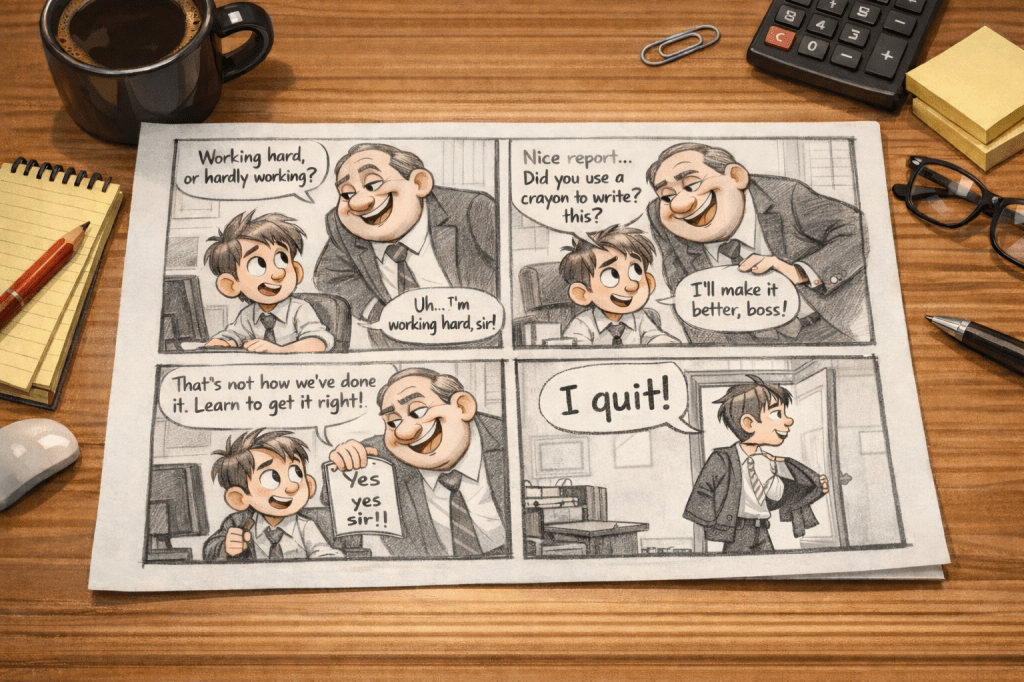
What unfolded before my eyes was a masterpiece. A full-page, hand-drawn comic strip titled “The Nightly Adventures of Tech Support Leo: A Final Episode.”
I sat back in my ergonomic chair (thank you, company wellness initiative) and let out a low whistle. The artwork was genuinely impressive, clean lines, expressive characters, dynamic paneling. Leo had clearly missed his calling as a graphic novelist. But as I began reading the panels, my admiration for his artistic skills quickly gave way to a creeping sense of dread.
Panel one showed a cheerful stick-figure Leo arriving for his shift, laptop bag slung over his shoulder, a little speech bubble reading, “Ready to save the day!” Panel two depicted a considerably less cheerful figure looming over him, unmistakably our graveyard shift manager, Jack Morrison, complete with his signature coffee mug and permanently furrowed brow. The speech bubble read, “That’s NOT how we do things here, kid.”
By panel five, Comic Leo was hunched over his workstation, surrounded by floating criticism bubbles: “You’re doing it wrong.” “In MY day, we didn’t need fancy new tools.” “Maybe you should go back to school.” The final panel showed Leo walking away toward a sunrise, a new company badge gleaming on his chest, with the caption: “Found a place where knowledge is celebrated, not punished. Thanks for the memories, Horizon Inc. Peace out. (with a hand emoji holding up two fingers)”
I set down my coffee cup carefully, as if sudden movements might somehow make the situation worse. Then I did what any responsible HR professional would do: I printed the comic strip in color (wasting a truly irresponsible amount of toner), pinned it to my corkboard, and began drafting an investigation plan.
Let me back up a bit and tell you about our cast of characters, because every good workplace drama needs context.
Leo Alvarez had joined Horizon Inc. exactly thirteen months prior as a Level 2 Technical Support Specialist on the graveyard shift. His resume had been impressive—a recent graduate with certifications in all the new technologies we’d been implementing: cloud infrastructure, containerization, the works. During his interview, he’d enthusiastically discussed his love for comic books and mentioned he did freelance illustration on the side. I’d found it charming. I’d even bought a print from his online shop for my nephew’s birthday.
The graveyard shift at Horizon Inc. is no joke. From 10 PM to 6 AM, this small team of four technicians is responsible for system monitoring, urgent incident response, and critical maintenance tasks that can’t be done during business hours. When the East Coast is sleeping and the West Coast is wrapping up, our graveyard crew is the thin line between smooth operations and total digital chaos. They handle everything from server updates to emergency patches, all while the rest of us are presumably drooling on our pillows.
Then there’s Jack Morrison. Jack had been with Horizon Inc. for ten years, starting back when we were a scrappy startup operating out of a converted warehouse in the industrial district. He’d seen the company grow from twenty employees to over two hundred. He’d been there when we used physical servers you could actually kick when they malfunctioned (not that anyone did that, officially). He was loyal, dedicated, and—as I was starting to realize, possibly drowning in a sea of technological advancement he didn’t quite understand.
Jack managed his team with what he probably thought was “old school” discipline. What he called “tough love,” others might call “being a colossal pain in the posterior.”
And then there was the HR angle Jack loved to mention. At least twice a month, someone would report that Jack had casually dropped comments like, “Yeah, Hailey and I go way back,” or “The HR director and I are grabbing drinks this weekend.”
Here’s the thing: I had never, not once, socialized with Jack Morrison outside of company events. The closest we’d come to “hanging out” was standing in the same vicinity at the annual holiday party while he monopolized the shrimp cocktail. The HR Director, Patricia, had once asked me if Jack was “okay” because he’d apparently told someone they were “old college buddies.” Patricia went to a University in Vermont. Jack went to community college. In Texas.
It was a classic case of fictional friendship, designed to make his reports think he had a direct line to HR protection. Spoiler alert: he did not.
I spent that Tuesday morning doing what I do best: detective work with a human resources twist. I pulled Leo’s file first. Performance reviews? Excellent across the board. Attendance? Perfect except for two sick days, both documented properly. Incident reports? Zero. Commendations? Three, including one from a client who’d specifically praised his patient troubleshooting during a critical outage at 2 AM.
Then I pulled Jack’s file. His early performance reviews were stellar. Words like “dedicated,” “knowledgeable,” and “team player” appeared frequently. But in the last two years, I noticed a pattern. His ratings had plateaued. Comments from his own supervisor mentioned “resistance to new training initiatives” and “struggles with updated protocols.” Just last quarter, there’d been a note about him declining to attend the advanced cloud architecture workshop, the third training session he’d skipped.
Most tellingly, there was a concerning trend in his team’s retention. In the past eighteen months, the graveyard shift had seen five departures. Five! In a team of four positions! People were rotating through that shift like it was a revolving door at a shopping mall on Black Friday.
I pulled out the exit interview notes. Most were diplomatically vague…”seeking new challenges,” “better hours,” “closer to home.” But one, from a technician named Priya who’d left six months ago, had a note I’d apparently glossed over at the time: “Management style didn’t align with my professional development goals.” HR-speak for “my boss was a nightmare.”
How had I missed this pattern? I made a note to implement better trend analysis in our exit interview process. This was on me, at least partially.
I picked up my phone and called Jimmy, one of the remaining graveyard shift technicians. We had a decent rapport, I’d helped him navigate his parental leave when his twins were born.
“Jimmy, hey, it’s Hailey from HR. Got a minute?”
“Sure, Hailey. What’s up?” I could hear the wariness in his voice. Nobody ever wants HR calling out of the blue.
“I’m following up on some team dynamics. Completely confidential. I need your honest take on something.” I paused. “How would you describe the work environment on your shift?”
The silence stretched for a beat too long. Then Jimmy sighed, a long exhale that spoke volumes.
“Honestly? Or HR honestly?” Jimmy asked.
“Jimmy. Real talk honestly.”
“It’s been rough, Hailey. Jack’s a good guy deep down, I think, but he rides the newer folks hard. Really hard. It’s like he’s trying to prove something, you know? Leo especially—Jack was on him constantly. ‘That’s not how I would do it.’ ‘Why are you using that new tool?’ ‘Back in my day…’ It got old fast.”
“Did Leo ever formally complain?” I asked.
“Not officially. But we all knew he was frustrated. We told him to talk to HR, but…” Jimmy trailed off.
“But what?”
“Jack’s always saying how tight he is with you guys. How he and the HR director are buddies. I think Leo figured it wouldn’t matter.”
I closed my eyes. Of course. The phantom friendship strikes again.
By Wednesday, I’d spoken with all three remaining graveyard shift technicians. Their stories aligned with depressing consistency. Jack micromanaged. Jack criticized. Jack particularly targeted anyone who demonstrated proficiency with the new systems he hadn’t mastered. And yes, Jack had created an atmosphere where people felt that reporting problems would be futile because of his fabricated HR connections.
I also did something I probably should have done sooner: I actually reached out to Leo directly. His email response was prompt and remarkably gracious.
“Hi Hailey, thanks for reaching out. I appreciated my time at Horizon Inc., and my coworkers were great. I learned a lot and I’m grateful for the opportunity. That said, I didn’t feel supported in my role, and I found a position elsewhere that’s a better fit. No hard feelings, but I won’t be returning. The comic strip speaks for itself. Best of luck to the team. – Leo”
Professional. Diplomatic. And yet, there was that comic strip, which definitely said everything he wasn’t putting in his polite email.
Time to talk to Jack.
I scheduled a meeting for Thursday morning, deliberately choosing a time after his shift had ended but before he’d left the building. I wanted him a little tired, a little off-guard. Is that manipulative? Maybe. Do I care? Not when I’ve got three burned-out employees and a comic strip resignation letter.
Jack arrived at my office at 7:00 AM, looking confused and slightly defensive. He’d clearly had time to hear through the grapevine that Leo had quit and that HR was “asking questions.”
“Jack, thanks for coming in. Have a seat.”
He sat, clutching his omnipresent coffee mug like a security blanket. “Is this about Leo? Because I can tell you, that kid had an attitude problem from day one.”
I didn’t respond immediately. Instead, I slid the printed comic strip across my desk. Jack picked it up, and I watched his expression cycle through confusion, recognition, and finally, a dull flush of embarrassment.
“He… he drew this?”
“He did. Quite talented, isn’t he?” I let that hang in the air. “Jack, I’m going to be direct with you. I’ve spoken with your entire team. I’ve reviewed the turnover rates. I’ve looked at training records. We need to talk about your management approach.”
“My management approach?” His voice rose slightly. “I’ve been doing this for ten years! These kids come in here with their fancy degrees thinking they know everything…”
“Jack.” I kept my voice calm but firm. “These ‘kids’ are trained professionals with current certifications in the technologies we use. Technologies that, according to your training records, you’ve declined to learn.”
The defensiveness cracked, just a little. Jack set down his coffee mug and rubbed his face with both hands. When he looked up, he suddenly seemed older, more tired.
“I… I know I’ve been difficult,” he admitted quietly. “It’s just… everything changed so fast, Hailey. One day I’m the expert, the guy people come to for answers. The next day, there’s cloud this and container that, and everyone’s speaking a language I barely understand. And these young techs, they make it look so easy.”
There it was. Not malice. Not cruelty. Fear. Inadequacy. The very human terror of being left behind.
I softened my tone. “Jack, why didn’t you attend the training sessions? We’ve offered multiple opportunities.”
He laughed, but it was bitter. “And admit I don’t know something? Admit that I’m struggling? I’ve built my reputation on being the guy who knows everything. If I show up to a training class with people I manage…” He shook his head. “It feels like failure.”
“So instead, you’ve been pushing away the people who do understand the technology. Particularly Leo.”
“I guess I have.” He picked up the comic strip again, studying it more carefully. “I didn’t realize I was this bad. But looking at this… I guess I was a bit overboard?”
It wasn’t really a question, but I answered anyway. “You created an environment where talented people felt diminished. Where asking questions or using new tools felt like an invitation for criticism. You particularly targeted Leo, who by all accounts was an exceptional employee.”
Jack was quiet for a long moment. “I didn’t mean to. I thought I was maintaining standards. Making sure things were done right.” He looked up. “What you’re really saying is I was protecting my ego at the expense of my team.”
“I’m saying that’s one interpretation, yes.” I exclaimed.
He set the comic down and met my eyes. “I owe them an apology. All of them. But especially Leo.”
“Leo’s already started his new job, Jack. He’s not coming back.” I reminded him.
The impact of that statement visibly hit him. “Because of me.”
“Because he didn’t feel valued or respected. Yes.”
We sat in silence for a moment. Outside my office window, the morning sun was climbing higher, marking the end of another graveyard shift. Somewhere out there, Leo was probably sleeping peacefully, free from Jack’s criticism. Here in my office, a ten-year veteran of Horizon Inc. was confronting some uncomfortable truths.
“What happens now?” Jack asked finally. “Am I fired?”
I’d been considering this question since Tuesday morning. “That depends on you. Here’s what I’m proposing.”
I laid out the plan I’d sketched with Patricia the previous evening. Jack would undergo a formal performance improvement plan focused on management skills and technical upskilling. He’d attend leadership coaching sessions, proper ones, with a professional coach who specialized in helping managers navigate technological transitions. Most importantly, he’d complete comprehensive training on all the new systems, but he’d do it on a different shift, away from his team. We’d bring in an interim manager, Sarah Alvarez (no relation to Leo, despite the coincidentally ironic surname), to lead the graveyard shift while Jack focused on his development.
“It’s not a demotion,” I clarified. “It’s a reset. You’re valuable to this company, Jack. Your institutional knowledge, your dedication, those matter. But you need to update your skills and, frankly, your approach to management. This is your chance to do both without the pressure of maintaining appearances in front of your team.”
Jack absorbed this, nodding slowly. “And if I refuse?”
“Then we’d need to have a different conversation about your future with Horizon Inc.”
“But I do this, complete the training, work with the coach… then what?”
“Then we evaluate whether returning to team leadership is the right fit, or whether there’s a different role that better suits your strengths. Maybe you become a specialist. Maybe you mentor new employees on company culture and history. Maybe you return to leading the graveyard shift. We’ll figure it out together.”
He was quiet for a long time. Then: “I want to apologize to them. The team. Is that… would that be appropriate?”
“I think that would be very appropriate, yes.” I acknowledged.
“And Leo? Can I reach out to him?” Jack requested.
I considered this. “I can provide his contact information if he’s agreeable. But Jack, if you do reach out, it needs to be a genuine apology. Not an excuse. Not a justification. Just… acknowledgment and regret.”
“I understand.” Jack answered.
Three weeks later, I received an email from Leo. The subject line read: “Update and Thanks.”
“Hi Hailey, Just wanted to let you know Jack reached out and apologized. It was genuine and thoughtful. I appreciated it, even though I’m happy where I am now. I heard he’s doing training and working with a coach, that’s great. Good managers aren’t born, they’re made, right?
I looked over at my corkboard, where Leo’s resignation comic still hung. It had become something of a conversation piece. Other HR colleagues who visited my office would ask about it, and I’d tell them the story. Some laughed. Some cringed in recognition of similar situations they’d handled. One borrowed it to use as a case study in a management training seminar.
But mostly, it served as a reminder: people don’t leave jobs, they leave managers. And sometimes, it takes a creative resignation, a hand-drawn comic strip, a dramatic exit, a wake-up call rendered in pen and ink, to expose truths that performance reviews and anonymous surveys can’t capture.
I turned back to my computer, queuing up my next task, but not before glancing once more at the comic strip. In the final panel, Leo’s character walked toward a new sunrise, shoulders squared, confidence restored.
Good for him, I thought. Good for him.
And maybe, eventually, good for Jack too.
Every story deserves a chance at a better ending, even the workplace ones.
Epilogue:
Six months later, Jack successfully completed his performance improvement plan and returned to the graveyard shift—not as manager, but as a senior technical specialist and mentor. He helped onboard new employees, sharing both technical knowledge and hard-won lessons about humility, growth, and the importance of treating every team member with respect. Sarah remained as the graveyard shift manager, and by all accounts, the team thrived.
Best resignation letter ever.


Leave a comment