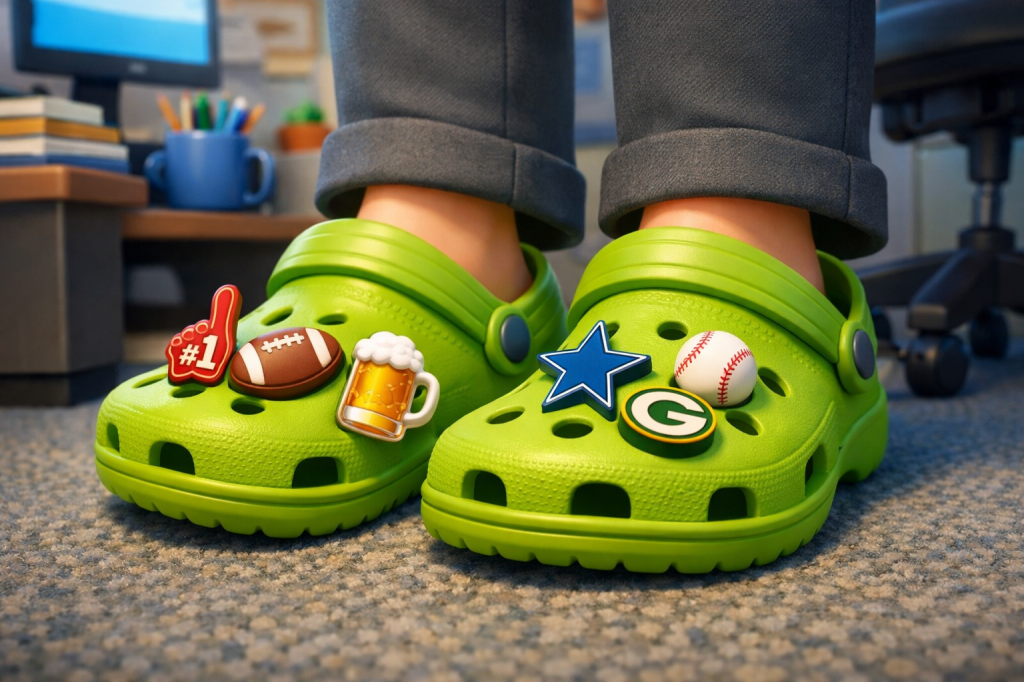
You know that feeling when you’ve crafted what you believe to be a perfectly reasonable policy, thoughtful, balanced, designed to make everyone’s lives better; and then someone finds the one loophole you never imagined existed? That’s how I felt the Tuesday morning when Lisa Halloway, Accounting Manager, appeared at my office door with an expression that can only be described as “professionally distressed.”
“Vanessa,” she said, closing the door behind her with the kind of deliberate care that signals an impending HR situation, “we need to talk about Enrico’s footwear.” I’m Vanessa Lopez, Head of People Operations by the way.
I should have known. Three weeks. Three weeks was all it took for my beautifully worded business casual policy revision to face its first existential crisis. I’d spent hours on that policy, carefully selecting each phrase, imagining the grateful employees working comfortably in their tasteful jeans and clean sneakers, the office humming with productive energy and casual Friday vibes every single day. I’d even gotten approval from the C-suite by promising it would “boost morale and increase in-office attendance.”
Nowhere in my fever dream of corporate utopia did I envision this moment.
“His footwear,” I repeated, already reaching for the bottle of ibuprofen I keep in my desk drawer for occasions like this.
“His Crocs, specifically.” Lisa exclaimed.
Of course. Of course it was Crocs.
Lisa settled into the chair across from my desk with the weary posture of a woman who has already fought this battle once and lost. “He wore them today. Lime green. With… decorations.”
“Decorations?” I inquired.
“Little charm things. Sports teams. And I believe one of them is a tiny beer mug.”
I closed my eyes and counted to five, which is as high as I usually get before corporate reality reasserts itself. “Tell me more.”
The story, as Lisa relayed it, was both predictable and somehow still surprising. The new dress code policy, my baby, my carefully balanced masterpiece of workplace flexibility, had gone into effect exactly three weeks ago. The response had been overwhelmingly positive. People showed up in their comfortable jeans and favorite sneakers. The vibe was relaxed but professional. I’d even caught myself thinking, during a Thursday afternoon walk through the office, that I might actually be good at this job.
Then this morning, Enrico Alvarez from Accounting had shuffled in wearing what Lisa described as “weapons-grade lime green Crocs” adorned with an array of Jibbits that transformed his footwear into a walking billboard for the San Francisco 49ers, the Golden State Warriors, Corona beer, and a miniature pizza slice.
“The thing is,” Lisa continued, her voice taking on the particular exhaustion of a manager who knows she’s about to have to enforce a rule that doesn’t technically exist yet, “people noticed. I got three Slack messages before 9 AM asking if that was ‘allowed under the new policy.’”
“What did you tell them?” I asked.
“That I’d look into it. Then I looked into it.” She pulled out her phone and read from the screen. “‘Attire must be business appropriate but comfortable. No shorts, t-shirts, pajamas, open-toed sandals, house slippers, torn or wrinkled clothing, and must be presented as clean and neat. Jeans, polos, and sneakers are acceptable.’”
We sat in silence for a moment, both of us staring at the words I’d written with such optimism.
“They’re not technically sandals,” I said finally.
“That’s what Enrico said too.” Lisa stated.
I should mention that Enrico Alvarez is not a troublemaker. He’s been with Lorwyn Enterprises for six years, consistently receives solid performance reviews, and has never once appeared on my radar for anything more serious than occasionally forgetting to submit his timesheet on Friday. He’s the kind of employee who exists in that pleasant middle zone of competence and invisibility that makes my job easier.
Which is why, when Lisa brought him to my office an hour later, I was genuinely curious about his reasoning. Surely he had one. Nobody wears lime green Crocs decorated with beer Jibbits to an accounting office without at least a theory.
Enrico walked in with the posture of a man ready to defend his dissertation. The Crocs, I had to admit, were even more aggressively lime than I’d imagined. They practically glowed. The Jibbits caught the fluorescent office lighting and sparkled with what I can only describe as defiant cheerfulness.
“Enrico,” I began, gesturing to the chair Lisa had vacated, “I understand you have some thoughts about the dress code policy.”
“I do.” He sat down, crossed his legs, and the Crocs squeaked. We all pretended not to notice. “I’ve actually prepared some points.” Enrico included.
Of course he had.
“I believe,” he started, and I could hear the carefully rehearsed quality to his words, “that Crocs should be considered acceptable professional footwear under our new business casual guidelines.”
“Go on.” I said.
“Nurses wear them. Professional chefs wear them. These are respected professions where people are on their feet all day in high-pressure environments, and Crocs are considered not just acceptable but actually recommended for comfort and safety.”
I had to hand it to him; it wasn’t a terrible argument. Cynical, yes. Deliberately obtuse, absolutely. But not terrible.
“If they’re professional enough for someone performing surgery or running a Michelin-starred kitchen,” he continued, warming to his theme, “why aren’t they professional enough for someone reconciling spreadsheets in a climate-controlled office?”
“Those are excellent points,” I said, watching his expression shift from defensive to hopeful. “Now let me ask you something. Do the nurses and chefs wear lime green Crocs covered in sports team logos and tiny beer mugs?”
The hope dimmed slightly. “Some of them might.” He added coyly.
“Do they?” I inquired with a slight grin.
“Probably not.” Enrico concluded.
Here’s what nobody tells you about being Head of People Operations: most of your job is trying to anticipate which hill people are going to choose to die on, and then figuring out how to evacuate them from that hill before anyone actually has to die.
Enrico’s hill was apparently made of foam resin and came in limited edition colors.
“Look,” Enrico said, and now the cynicism was creeping into his voice properly, “I get it. They’re not conventional. But the policy doesn’t say anything about conventional. It says comfortable and business appropriate. These are comfortable, ergonomically designed, actually, and I’ve established that they can be business appropriate in the right context.”
“The beer mug charms, Enrico.”
“The policy doesn’t mention jibbits.” He stated hesitantly.
“The policy also doesn’t specifically mention that you can’t wear a sombrero, but I think we’d both agree…”
“Are you comparing my footwear to a sombrero?” Enrico asked satirically.
Lisa made a small noise that might have been a suppressed laugh or a cry for help. It was hard to tell.
I took a breath. “I’m going to need some time to consider this. In the meantime, would you be willing to wear different shoes while I review the situation?”
Enrico’s jaw tightened. “With all due respect, Vanessa, no. I don’t think I should have to change my footwear when I’m not violating any written policy. That’s the whole point of having written policies, isn’t it? So, we’re not subject to arbitrary decisions based on someone’s personal preferences?”
Damn it. He had a point. An annoying, technically correct point.
“Give me until end of day tomorrow,” I said. “I’ll review the policy and get back to you with a decision.” I stated conclusively.
He nodded, stood, and squeaked his way out of my office, leaving behind a faint rubbery and slightly pungent odor of bare feet marinating in Crocs all morning.
After he left, Lisa looked at me with something approaching sympathy. “What are you going to do?”
“What I always do,” I said, already pulling up my calendar. “Due diligence, stakeholder interviews, and probably a lot of coffee.”
The next morning, I started my investigation. I’d learned early in my career that in situations like this, perception is everything. It doesn’t matter what I think about Enrico’s Crocs, or even what Lisa thinks. What matters is how they’re affecting the office environment.
My first interview was with Jennifer from Marketing, whose desk was approximately fifteen feet from Enrico’s.
“Honest opinion,” I said, settling into the chair across from her desk. “The Crocs. Thoughts?”
Jennifer didn’t even hesitate. “They’re a lot.”
“Elaborate?”
“They’re very green. Like, aggressively green. And the little charms are kind of distracting. I found myself staring at them during yesterday’s budget meeting trying to figure out what they all were. I missed an entire discussion about Q4 projections because I was wondering if that was a tiny taco or a tiny pizza slice.”
“Pizza,” I confirmed.
“See? I should have been paying attention to the meeting.” Jennifer added.
My second interview was with Marcus from IT, who shared a workspace pod with Enrico.
“Look,” Marcus said, leaning back in his chair, “I don’t care what the guy wears on his feet. Live and let live, you know? But…” He hesitated.
“But?” I inquired.
“There’s kind of a smell situation.” Marcus added crinkling his nose.
My stomach dropped. “A smell situation.”
“He’s wearing them barefoot. No socks. And by the end of the day…” Marcus made a face. “Let’s just say the pod is getting a little ripe.”
Of course. Of course there was a smell situation. Because why would any workplace conflict be simple and straightforward?
By lunch, I’d talked to five more people. The consensus was clear: nobody actively hated the Crocs in principle, but the lime green color was described variously as “intense,” “a choice,” and “like looking directly at a highlighter.” The Jibbits were considered “unprofessional” by some and “honestly kind of funny” by others. But the barefoot situation was universally condemned.
“It’s a hygiene thing,” explained Patricia from my HR team, who I’d saved for last because I knew she’d give me the most diplomatic answer. “I mean, I wear my closed-toed Birkenstocks with socks specifically because nobody wants to smell feet in an office environment. It’s just basic consideration.”
“The policy doesn’t mention socks,” I said, more to myself than to her.
“The policy probably assumed we were all adults who understood basic office etiquette.” Patricia added.
I laughed despite myself. “Never assume that.”
That afternoon, I called Enrico back to my office. He arrived with the same defensive posture as before, and I noticed he’d added a new Jibbit, a tiny rubber ducky, since yesterday.
“I’ve done my due diligence,” I began. “Talked to several colleagues, reviewed the policy language, and given this situation considerable thought.”
He nodded, waiting.
“Here’s my decision: Crocs can be worn in the office under the business casual policy.”
His face lit up. “Really?”
“However,” I continued, and watched the light dim again, “there are conditions. No jibbits or charms of any kind. The Crocs must be a solid, neutral color—black, white, navy, or gray. They must be clean and well-maintained. And most importantly, they must be worn with socks.”
“Socks?” he asked looking bewildered.
“Socks, Enrico. Non-negotiable.”
He processed this for a moment. “So I can wear Crocs, just not these Crocs.”
“Correct.” I stated.
“That seems like a compromise designed to make me give up entirely.” Enrico said deflatingly.
I shrugged. “It’s a compromise designed to address the legitimate concerns raised by your colleagues while still honoring your argument that Crocs can be professional footwear. You were right, nurses and chefs do wear them professionally. But they wear solid colors, they keep them clean, and I’m willing to bet most of them wear socks.”
Enrico stared at his lime green, Jibbited feet for a long moment. I could see him running calculations, weighing his options, deciding whether this was really the hill he wanted to die on.
“Can I ask,” he said finally, “what were the specific complaints?”
I’d been expecting this question. “The color was considered distracting. The charms were seen as unprofessional by some. And the barefoot situation was… let’s call it universally unpopular.”
“The barefoot situation,” he repeated.
“There were concerns about odor.” I declared.
His face flushed. “I…oh god. I didn’t realize!”
“It’s a common issue with wearing any closed-toe shoe without socks,” I said quickly, trying to save him some dignity. “Not specific to you or your Crocs. It’s actually why the sock requirement is now in writing.”
He nodded slowly, and I could see his entire defensive posture slumping. The righteous crusader for Croc justice was becoming just a guy who’d maybe made his colleagues’ workspace smell like feet and was now deeply embarrassed about it.
“For what it’s worth,” I added, “your argument about professional contexts wasn’t wrong. You made me think more carefully about what ‘business appropriate’ actually means. The policy needed this clarification regardless of how we got here.”
“So, I’m… helping?” he asked.
“Let’s say you’re contributing to the evolution of Lorwyn Enterprises’ workplace culture. How’s that?” I replied.
He managed a small smile. “I can work with that.”
“And Enrico? The solid color, sock-wearing Crocs? I think they’ll actually look fine. Professional, even. Just maybe not lime green with a beer mug on them.”
After he left, squeaking away for what I suspected might be the last time, I updated the dress code policy document with a new subsection under footwear: “Crocs and similar casual comfort shoes are acceptable provided they are solid neutral colors (black, white, navy, gray), free of decorations or charms, kept clean, and worn with appropriate socks.”
Three days later, watching Enrico walk past my office in his sensible black Crocs and white socks, I felt something almost like victory. He was able to be comfortable. His colleagues got to work in an odor-free environment. The policy got clearer. Nobody had to die on their hill.
In the world of People Operations, that’s about as good as it gets.
I took another sip of coffee and opened my email. There was already a new message waiting: “Question about the dress code policy, can we wear baseball caps?”
I closed my laptop.
Some battles would have to wait until tomorrow.


Leave a comment