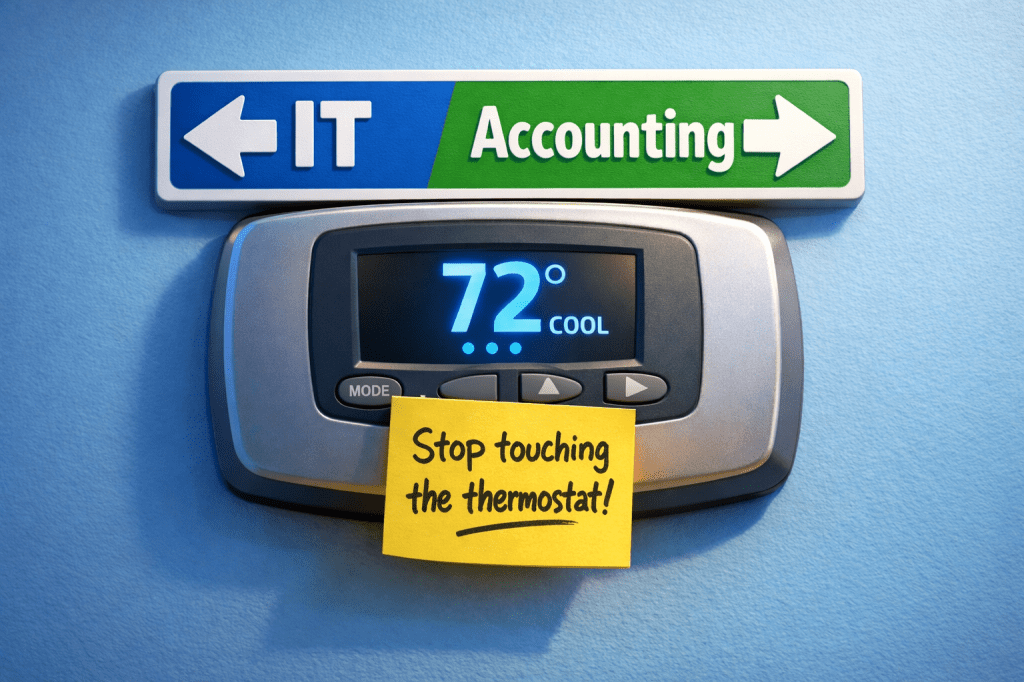
You know, when I decided to go into Human Resources five years ago, I imagined myself navigating complex employee relations issues, facilitating meaningful career development conversations, and perhaps mediating the occasional personality conflict. What I did not imagine was becoming a battlefield correspondent in what would come to be known around Vault Solutions as “The Great Thermostat Wars.” But here we are.
Hello, I’m Russ from HR by the way.
Let me set the scene for you. It’s a Tuesday morning in March, and I’m sitting at my desk with my third cup of coffee, thinking this might actually be a quiet week. My inbox has a manageable number of emails, nobody’s scheduled any “urgent” meetings with mysterious subject lines, and I’m feeling pretty good about life.
That’s when Tim and Jill appear in my doorway.
Now, Tim and Jill are two of my favorite managers to work with. Tim oversees our IT team, think hoodies, mechanical keyboards that click loud enough to wake the dead, and an inexplicable devotion to energy drinks. Jill manages our Accounting team, sensible cardigans, color-coded spreadsheets, and a tea collection that could rival a small café. They’ve worked on the same floor, sharing the same office space, for over five years without so much as a sideways glance at each other.
The expressions on their faces this particular morning suggest that their peaceful coexistence has come to an end.
“Russ,” Tim says, and I can already tell this is going to be interesting. “We have a situation.”
Jill nods gravely, clutching a folder to her chest like it contains state secrets. “A temperature situation.”
I set down my coffee. In HR, you learn to read the room quickly, and the room is telling me that whatever comes next is going to be simultaneously ridiculous and deadly serious. “Okay. Why don’t you both have a seat and tell me what’s going on?”
They settle into the chairs across from my desk, and I notice they’re sitting as far apart as physically possible while still being in the same seating area. This is not a good sign.
Tim goes first. “My team is melting. Literally melting. Sara said yesterday that she felt like she was trying to code while sitting inside a toaster oven. Maurice has started bringing a personal desk fan that sounds like a helicopter taking off. And Kevin, well, Kevin just works shirtless now when he thinks no one’s looking.”
“Please tell me Kevin is at least wearing an undershirt,” I say.
“Tank top,” Tim confirms. “It’s very unprofessional, and also, none of us needed to know he has a tattoo of Yoda on his shoulder blade that says ‘Code or Code Not, There Is No Try.’”
I make a note. Actually, I just doodle a stick figure wearing a tank top because I’m not sure what else to write.
Jill jumps in. “Well, Russ, while Tim’s team is allegedly ‘melting,’ my team is turning into popsicles. Lydia has started wearing her winter coat indoors. Charles brought in a space heater that keeps tripping the circuit breaker. And Patricia, bless her heart, has taken to doing jumping jacks between tax calculations just to keep her blood flowing.”
“Jumping jacks,” I repeat.
“Vigorous jumping jacks,” Jill emphasizes. “In her office. It’s very distracting.”
I lean back in my chair, already sensing where this is going. “Let me guess. This is about the thermostat.”
They both nod in unison, and for a brief moment, they’re united in their misery.
“The thermostat,” Tim says, “has become a war zone.”
Jill opens her folder and pulls out what I can only describe as a hand-drawn chart that looks like it was created by someone who has completely lost their grip on reality. It’s a timeline, color-coded in highlighter, with timestamps and temperatures recorded in fifteen-minute intervals.
“I’ve been documenting the changes,” Jill says, and there’s a slight manic gleam in her eye that concerns me. “On Monday alone, the thermostat was adjusted forty-seven times.”
“Forty-seven?” I’m genuinely impressed by this level of pettiness.
“Forty-seven,” she confirms. “It started at sixty-eight degrees at eight AM. By eight-fifteen, someone had changed it to sixty-two. By eight-thirty, it was back up to seventy-four. By nine o’clock, we were at fifty-nine degrees, and Lydia was researching whether frostbite could be considered a workplace injury.”
Tim crosses his arms. “My team needs it cool to think clearly. Have you ever tried debugging code when you’re sweating through your shirt? The heat makes everything foggy. We need it at sixty-five degrees, maximum.”
“And my team,” Jill counters, “needs warmth to concentrate. Have you ever tried to reconcile a balance sheet when your fingers are so cold you can’t feel the keyboard? We need it at seventy-two degrees, minimum.”
I do some quick mental math. This is a seven-degree difference, which in normal circumstances would not seem insurmountable. But these are not normal circumstances.
“Tell me about the thermostat setup,” I say, pulling out my laptop to take actual notes now.
Tim sighs. “There’s one thermostat for the entire floor. It controls both the IT area and the Accounting area. Some brilliant facilities decision from when the building was renovated three years ago. We used to have two zones, but then they ‘streamlined’ everything’.
“Streamlined us right into chaos,” Jill mutters.
“And you’re saying this has gotten serious recently? You’ve both been on this floor together for five years. Why is this becoming a problem now?”
They exchange glances, and I see something pass between them, a moment of shared confusion.
“It’s weird,” Tim admits. “We’ve never had issues before. I mean, sure, someone would adjust the temperature here and there, but it was never like this. Never this… aggressive.”
“It started about six weeks ago,” Jill says, consulting her timeline. “Maurice adjusted the thermostat down to sixty-three because he said he was ‘overheating after climbing the stairs.’ Then Lydia changed it to seventy-one because she said her ‘arthritis was acting up.’ Then Sara changed it back down. Then Charles changed it back up. And then…” She trails off, gesturing helplessly at her chart of chaos.
“And then it escalated,” I finish for her.
“Exponentially,” Tim confirms. “Now people are camping out near the thermostat. They’re setting phone alarms to check it every thirty minutes. Someone, I’m not naming names, created a Slack channel called ‘Thermostat Watch’ where they alert each other when the temperature changes.”
I blink. “A Slack channel.”
“With forty-three members,” Jill adds. “Apparently some people from other floors joined just to watch the drama unfold. Someone started taking bets.”
This is, without question, the most absurd thing I’ve dealt with since the Great Microwave Fish Incident of last year, and that ended with a revised break room policy and three people transferring to different floors.
“Okay,” I say, trying to organize my thoughts. “What have you two tried so far to resolve this?”
They look at each other again, and I see the problem immediately. They haven’t tried anything together. They’ve been managing their own teams, listening to their own complaints, and probably feeling defensive about their people’s needs.
“I sent an email to my team,” Tim says, “asking them to be respectful of shared spaces and to consider their colleagues.”
“I sent basically the same email,” Jill admits. “I also suggested people dress in layers.”
“That’s when Charles brought in the space heater that keeps killing the power,” Tim says pointedly.
“And that’s when Kevin started with the tank tops,” Jill shoots back.
I hold up my hands. “Okay, look. You’re both reasonable people. You’ve worked together successfully for years. Your teams are both full of adults who can presumably function in society. This should not be this hard.”
“But it is,” they say simultaneously.
I sit with this for a moment, staring at Jill’s temperature chart and trying to figure out why this particular issue has become so contentious. And then it hits me.
“It’s because everyone’s working in the office full-time again, isn’t it?”
They both pause, and I can see the realization dawning on their faces.
“We went back to five days in-office about two months ago,” Tim says slowly. “Before that, we were hybrid. People were only in the office two or three days a week.”
“So, the temperature differences were annoying,” I continue, “but not constant. Now people are here every single day, sitting in spaces that feel consistently too hot or too cold, and they’re frustrated.”
“And taking it out on the thermostat,” Jill finishes. “Like the thermostat is the enemy, when really it’s just…”
“An inanimate object caught in the crossfire,” I say. “Exactly.”
We sit in silence for a moment, contemplating the absurdity of it all. Then I pull up a fresh document on my laptop.
“Alright, here’s what we’re going to do. We’re going to solve this, but we need to be creative. Neither of your teams can feel like they lost, and we can’t just mandate the temperature and tell everyone to deal with it. That’ll breed resentment.”
“Agreed,” Tim says.
“Completely,” Jill adds.
I start typing out ideas, thinking out loud. “First, we need to acknowledge that this isn’t really about the thermostat. It’s about comfort and control. People want to feel comfortable in their workspace, and they want to feel like they have some say in their environment.”
“Right,” Jill says, leaning forward. “But we can’t give everyone individual climate control.”
“No, but we can give them other options. What if we approached this from multiple angles?” I’m getting excited now, which is probably a sign that I’ve been in HR too long. “What if we got some personal solutions in place—approved space heaters that won’t trip breakers, desk fans, maybe even some of those wearable personal cooling devices?”
Tim nods slowly. “That could work for some people. But we’d need to make sure it’s equitable—both teams get access to the same resources.”
“Absolutely. And we set a neutral thermostat temperature—somewhere in the middle. Maybe sixty-eight or sixty-nine degrees. Then people can adjust their personal comfort from there.”
Jill is making notes now too. “What about the actual thermostat access? We need to stop the constant changing.”
“Thermostat diplomacy,” I announce, and I’m proud of this phrase. “What if we created a schedule? One team has ‘priority’ in the morning, the other in the afternoon. Priority just means they can set it within an agreed-upon range—say, sixty-seven to seventy degrees—and it doesn’t get changed during their time block.”
“Like shared custody,” Tim says, “but for temperature control.”
“Exactly like that, yes.”
We spend the next hour hammering out the details. Jill suggests we bring in both teams for a joint meeting to present the solution and get buy-in. Tim recommends we also look into better ventilation for the IT area specifically, since they have more heat-generating equipment. I propose we frame this not as a rule from management but as a collaborative agreement between the teams, a Temperature Treaty, if you will.
By the time we’re done planning, I’m feeling hopeful. We’ve got a multi-pronged approach: personal comfort devices for both teams, a scheduled thermostat rotation system, an agreed-upon temperature range, some facilities improvements, and most importantly, a framework for the teams to communicate directly with each other if issues arise.
“I think this could actually work,” Jill says, and she sounds surprised.
“Of course it’ll work,” I say with more confidence than I feel. “We’re going to turn this thermostat war into a thermostat peace accord.”
Tim grins. “Should we make actual documentation? Like, a physical treaty they can sign?”
“You know what? Yes. Let’s do that. Let’s make this official and slightly ridiculous. People respond well to humor, especially when they’ve been taking something way too seriously.”
We schedule the joint team meeting for Friday afternoon. I volunteer to create the “Treaty” document, complete with official-looking language and a place for representatives from each team to sign. Jill says she’ll work with Facilities to get the approved comfort devices ordered. Tim offers to create a simple online scheduling system for the thermostat rotation.
As they’re leaving my office, they’re actually talking to each other, laughing about how absurd this whole situation has become. It’s a good sign.
“Hey,” I call after them. “One more thing. This whole situation? It’s a good reminder that sometimes the smallest things can become the biggest problems if we don’t address them. You two did the right thing by coming to me before this turned into something that affected team morale or working relationships.”
“Thanks, Russ,” Jill says. “Sorry it took forty-seven thermostat changes before we asked for help.”
“Forty-eight,” Tim corrects. “Maurice definitely changed it again after you started documenting.”
The Friday meeting goes better than I could have hoped. We gather both teams in the large conference room, and I start by acknowledging the elephant in the room—or rather, the thermostat on the wall.
“So,” I say, “I hear we’ve been having some temperature disagreements.”
The room erupts in overlapping complaints and accusations, everyone talking over each other. I let it go for about thirty seconds, long enough for people to vent, short enough that it doesn’t devolve into chaos.
Then I unveil The Temperature Treaty.
I’ve printed it on fancy paper, complete with a wax seal (courtesy of a craft store and my commitment to the bit). I read it aloud, including gems like “Whereas both parties acknowledge that the thermostat is not, in fact, a toy” and “The undersigned agree that passive-aggressive temperature changes are hereby banned under penalty of having to explain their actions to Russ.”
People start laughing. The tension breaks.
We go through the solutions: personal fans and heaters, the rotation schedule, the agreed-upon range. Representatives from each team, Maurice from IT and Lydia from Accounting, sign the treaty with exaggerated formality. Someone suggests we frame it and hang it next to the thermostat. This is immediately approved by popular vote.
In the weeks that follow, the system works. It’s not perfect, there’s a minor dispute when someone sets the thermostat to seventy-one during IT’s time slot, leading to a formal “treaty violation” meeting that’s really just me, Tim, Jill, and the offender sharing cookies and talking about respecting boundaries. But mostly, people adjust. They use their personal devices, they appreciate having some control over their environment, and they stop obsessing over every single degree change.
Three months later, Tim and Jill stop by my office again. For a moment, I panic, thinking we’re about to discuss some new crisis.
“Just wanted to say thanks,” Tim says. “The thermostat thing has been completely fine. Haven’t had a single complaint in weeks.”
After they leave, I lean back in my chair and smile. Five years in HR, and I’ve learned that sometimes the biggest battles are fought over the smallest things. But I’ve also learned that with a little creativity, a willingness to listen, and occasionally a ridiculous treaty with a wax seal, even the most absurd conflicts can be resolved.
Somewhere down the hall, the thermostat sits at a comfortable sixty-eight degrees. The Treaty hangs framed beside it, a reminder that we’re all in this together.
And Kevin, I’m pleased to report, is wearing a proper shirt again.


Leave a comment